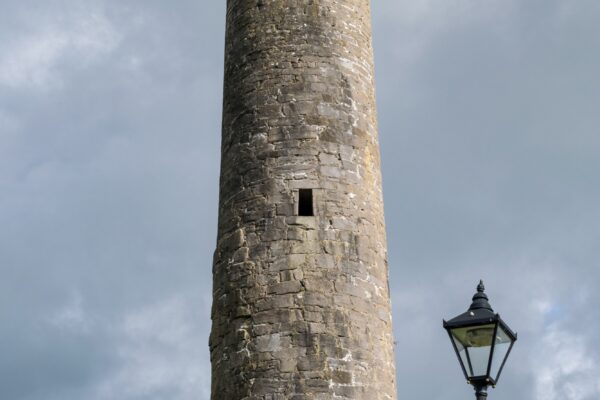
Lost Round Tower at Killeshin, Co. Laois
Co. Laois |
Round Towers
Ireland's tallest round tower took three days of professional undermining to topple in 1703, but when 105 feet of medieval masonry finally crashed down, it hit the ground as "one solid piece"
This vanished round tower at Killeshin provides one of the most detailed and dramatically documented accounts of round tower demolition in Irish history. Standing 105 feet (32 meters) high—making it one of Ireland's tallest round towers—the structure survived until 1703 when it was deliberately undermined and destroyed in an act of calculated demolition that has left us with extraordinary contemporary records.
The Deliberate Demolition of 1703
The tower's destruction is documented with remarkable precision by Fitzgerald, who recorded that on "Monday ye 8th Day of March 1702/3, that day the Steeple of Killeshan undermined and flung down by one Bambrick, imployed by Captain Wolseley, in Three Days Works." The demolition was completed at "3 of the clocke in ye afternoon" when "ye Steeple fell to ye ground."
This account reveals the demolition as a professional operation rather than accidental collapse—Bambrick spent three days undermining the structure under Captain Wolseley's orders, suggesting either military engineering or experienced demolition expertise. The precision timing and methodology indicate this was a planned destruction rather than gradual decay.
Exceptional Height and Construction Quality
At 105 feet (32 meters), Killeshin's round tower ranked among Ireland's tallest, comparable to the famous examples at Ardfert (which various sources measured at 100-150 feet) and significantly taller than most surviving examples. This extraordinary height would have made it a dominant landmark visible across the Laois countryside and a point of reference for travelers for miles around.
Remarkable Structural Integrity
What makes the Killeshin demolition account truly extraordinary is the description of how the tower fell. Despite its great height, when deliberately undermined, "it came to the ground in one solid piece, and was not even by the fall against the ground so broke, but that several pieces yet remain sticking together."
This account suggests the medieval builders achieved exceptional structural unity—the tower was so well-constructed that even when its foundation support was removed and it fell 105 feet, large sections remained intact. This speaks to both the quality of medieval mortar and the precision of the stone-fitting that created a monolithic structure rather than a collection of individual stones.
Contemporary Assessment of Medieval Quality
The 1709 account provides valuable contemporary assessment of medieval Irish construction techniques. The observer noted the tower was "very high old and well built" and "plainly appears to be of the same building & age with the adjacent Church." This suggests both the tower and church were conceived as part of a unified architectural program, representing significant ecclesiastical investment at the Killeshin site.
Archaeological Implications
Despite the tower's dramatic collapse and the survival of large intact sections as late as 1709, no visible surface remains exist today in the northwest quadrant of the graveyard where it presumably stood. This complete disappearance suggests the fallen stones were eventually broken up and removed—possibly for building materials or to clear the graveyard for continued burial use.
The absence of any foundation traces also indicates either extremely thorough stone removal or significant soil accumulation over the intervening centuries. For such a massive structure to leave no archaeological trace represents a remarkable example of how completely historic monuments can vanish from the landscape.
Historical Context of Destruction
The 1703 demolition occurred during a period when many Irish medieval monuments were being destroyed, either through neglect, deliberate removal, or conversion to other uses. Captain Wolseley's role suggests this may have been connected to land clearance, safety concerns about a deteriorating structure, or simply the practical need for building stone.
The professional nature of the demolition—employing Bambrick for three days of undermining work—indicates this was not vandalism but a considered decision, possibly by a landlord concerned about liability or seeking to "improve" the property by removing medieval "ruins."
Loss to Irish Heritage
The destruction of Killeshin's round tower represents one of the most significant documented losses in Irish medieval architecture. A 32-meter tower with exceptional construction quality would have provided invaluable evidence about advanced medieval building techniques and served as one of Ireland's most impressive surviving round towers.
Good to Know
Location: Killeshin, County Laois (SW of church formerly in NW quadrant of graveyard)
Height: 105 feet (32 meters) - among Ireland's tallest round towers
Demolished: March 8, 1703 (deliberately undermined)
Demolition agent: Bambrick, employed by Captain Wolseley
Construction quality: Described as "very high old and well built," fell as "one solid piece"
Current status: No visible remains, completely vanished
Historical significance: One of the most detailed contemporary accounts of round tower demolition
Tags
- 105 feet tall, Bambrick demolition, Captain Wolseley, County Laois, deliberate demolition 1703, fell intact, Killeshin, lost round tower, medieval construction quality, professional undermining
Visitor Notes
Added by