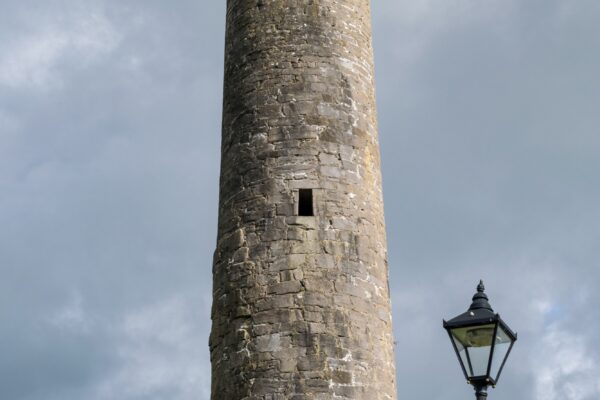
Lost Round Tower at Rosenallis, Co. Laois
Co. Laois |
Round Towers
A narrow tower of rough stone stood peacefully in County Laois until a Protestant minister declared it an obstruction to progress and demolished it for being useful only to "cracked people called antiquarians and jackdaws."
This vanished round tower at Rosenallis represents one of Ireland's most controversial and deliberately destroyed medieval monuments, demolished by a Protestant minister who viewed it as an obstruction and dismissed antiquarian interest as the curiosity of "cracked people." The tower's destruction and the circumstances surrounding it provide a stark example of changing attitudes toward Ireland's medieval heritage in the 19th century.
Deliberate Destruction by Religious Authority
The round tower met its end through the deliberate action of a Protestant minister who, according to the OS Letters of 1838, "pulled down a slender steeple which stood opposite the door of this church because he found that it was in his way, and converted the stone to a more useful purpose than they had served."
The minister's justification reveals remarkable hostility toward both the medieval monument and those who valued it. He argued the stones would serve "a more useful purpose" than they had while "piled together in the shape of a steeple since the time of St. Bridget, that is to indulge the curiosity of a number of cracked people called antiquarians and to serve as a habitation for jackdaws."
This contemptuous dismissal of antiquarian interest reflects the broader cultural tensions of 19th-century Ireland, where medieval Catholic monuments were sometimes viewed by Protestant authorities as obstacles to progress rather than valuable heritage.
Physical Description and Comparisons
Contemporary accounts describe a structure significantly smaller and less impressive than typical Irish round towers. O'Donovan recorded how an old man remembered "a narrow steeple of rough masonry, not so high or well built as the Steeple of Timahoe"—suggesting it was a modest example compared to Laois's magnificent Timahoe tower.
Sir Charles Coote provided more detailed architectural observations, noting it was "not one third as high as those circular towers seen thro the kingdom, nor evidently was it built for the like purpose." His comparison to nearby windmill walls, which "bear strong resemblance to the tower just described, but the former has no entrance," raises intriguing questions about the structure's original function and design.
Questions of Authenticity and Function
Coote's observation that the tower was not "evidently built for the like purpose" as typical round towers, combined with his comparison to windmill remains, suggests this may have been an unusual or possibly later structure rather than a classic early medieval round tower. The lack of typical proportions and construction quality might indicate either a later imitation or a structure built for different purposes.
However, the tradition ascribing its erection to "O'Dun, Chief of Dooregan" and its association with "the time of St. Bridget" connects it to early Christian Ireland, suggesting local memory preserved its medieval ecclesiastical origins regardless of its unusual characteristics.
Location and Archaeological Evidence
The tower's location was precisely recorded as standing "between the gable-end of the old Protestant school and the road to Shanbeg." Despite this specific positioning, no surface remains are visible today, and the site is now marked only on Ordnance Survey maps as "site of Round Tower."
Local memory preserved the location for many years after demolition—"A large heap of stones was pointed out to me many years ago as the site of the tower"—but even this stone scatter has apparently been removed or scattered, leaving no trace of what was once a prominent village landmark.
Cultural and Historical Significance
The Rosenallis tower's destruction represents more than just the loss of a single monument—it symbolizes broader 19th-century attitudes toward Ireland's medieval past. The minister's dismissive language about "cracked" antiquarians reveals the cultural divide between those who saw medieval ruins as obstacles to modernization and the emerging antiquarian movement that recognized their historical value.
The incident also illustrates the practical pressures faced by medieval monuments in expanding communities, where ancient structures could be viewed as impediments to development rather than assets to be preserved.
Legacy of Loss
The complete disappearance of all traces, from standing tower to stone heap to unmarked ground, demonstrates how thoroughly a medieval monument can vanish when subjected to deliberate destruction followed by continued disturbance. Unlike towers that collapsed naturally and left foundation traces, this systematically demolished structure was apparently quarried so completely that it left no archaeological signature.
Good to Know
Location: Rosenallis village, County Laois (between old Protestant school gable and Shanbeg road)
Status: Completely destroyed and vanished
Demolished by: Protestant minister (19th century)
Reason given: "Found it was in his way," stones converted to "more useful purpose"
Physical description: "Narrow steeple of rough masonry," much smaller than typical round towers
Traditional attribution: O'Dun, Chief of Dooregan; "time of St. Bridget"
Current condition: No surface remains, location marked only on OS maps
Tags
- 19th-century destruction, antiquarian hostility, County Laois, cracked antiquarians, deliberate cultural erasure, jackdaw habitation, lost round tower, Protestant minister demolition, Rosenallis, rough masonry
Visitor Notes
Added by